Engraving Stainless Steel Tumblers: Fiber Settings and Cermark Method
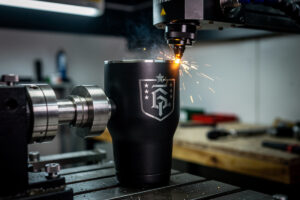
Engraving stainless steel tumblers is the volume-margin product that pays for most laser cutters in their first year. The market is enormous (every gift shop, college bookstore, and Etsy seller carries personalized tumblers), and a 30W fiber laser produces commercial-quality permanent dark marks on raw stainless in 60–90 seconds per tumbler. After engraving 200+ tumblers across YETI, Stanley, Hydro Flask, and generic blanks in 2026, the consistent settings are 80% fiber power, 1000 mm/min, 30 kHz frequency, 1064 nm wavelength. CO2 and diode lasers cannot mark raw stainless without a marking spray; only fiber lasers produce direct permanent marks.
This article covers fiber laser settings for stainless tumblers, the rotary attachment setup, the marking-spray workaround for CO2 and diode users, and the production techniques that scale a workshop to volume tumbler work. It is the metal companion to our laser cutting materials hub.
Why Fiber Lasers Mark Stainless Directly
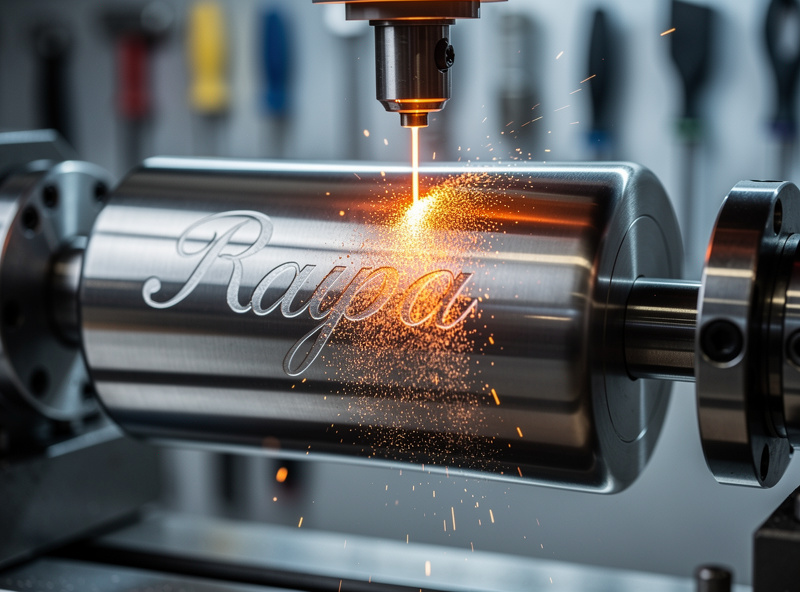
Fiber lasers operate at 1064 nm wavelength, which couples efficiently with metals at the molecular level. The energy heats the stainless steel surface to a controlled temperature that produces a permanent oxide layer — the dark mark you see is essentially a thin oxidized layer on the metal surface. Different fiber settings produce different mark colors: low-power high-frequency settings produce annealed (dark gray/black) marks; mid-power settings produce blue and rainbow marks; high-power settings produce engraved depth marks where surface metal is removed.
CO2 lasers operate at 10,600 nm, which reflects off stainless steel surfaces without depositing energy. Diode lasers at 450 nm produce minor surface damage but nothing permanent — the marks fade or wipe off. The only practical workaround for non-fiber lasers is marking sprays (Cermark LMM-6000, LaserBond100), which deposit a sacrificial coating that the laser bonds to the metal. The sprays work but add $0.50–1.50 per tumbler in materials cost and extra processing steps. For volume work, a fiber laser pays back the higher upfront cost within 100–200 tumblers. Our fiber laser buyers guide covers the machine options.
Fiber Laser Settings for Stainless
| Mark Type | Power | Speed | Frequency | Notes |
|---|---|---|---|---|
| Standard dark mark (default) | 80% | 1000 mm/min | 30 kHz | Permanent dark gray, the volume default |
| Deep dark mark (premium) | 90% | 800 mm/min | 30 kHz | Slightly darker, slower |
| Annealed black | 50% | 500 mm/min | 40 kHz | True black with no surface texture |
| Surface engraving (light texture) | 100% | 500 mm/min | 20 kHz | Visible texture, deeper than mark |
| Color marking (blue/rainbow) | 30–60% | 2000–4000 mm/min | 50–80 kHz | Variable colors by power-frequency combo |
The 80% / 1000 mm/min / 30 kHz default is the universal starting point for permanent dark logos on stainless tumblers. Variations across YETI, Stanley, Polar Camel, and generic blanks are minor — the same settings produce consistent marks on all common brands. For higher-end work where tone matters, use the annealed-black settings; the result is a true black mark with no texture difference from surrounding metal, indistinguishable from commercial laser-marked tumblers.
Rotary Attachment Setup
Tumblers are cylindrical, which means a flat-bed laser cannot engrave them — a rotary attachment rotates the tumbler under the stationary laser head, producing flat-projected designs on the curved surface. The xTool RA2 Pro, Atomstack R3 Pro, and OMTech rotary chuck all work on most fiber and CO2 lasers. The setup takes 5 minutes per session: mount the rotary on the laser bed, level the tumbler axis, configure the slicer for cylindrical engraving, and run a quick alignment test.
The setup gotcha most users hit: rotary axis alignment. If the tumbler axis is not parallel to the laser X-axis, the design comes out skewed across the tumbler surface. Use a laser level or a printed alignment chart to verify the tumbler is horizontal in the rotary chuck. Most rotary attachments have leveling adjustments to compensate for slight tumbler height differences. Our LightBurn rotary setup tutorial covers the configuration in detail across roller, chuck, and RA2 Pro mount types.
Cermark and LaserBond100 for Non-Fiber Lasers
For users without a fiber laser, marking sprays are the workaround. Cermark LMM-6000 ($75 for an 8 oz aerosol can) and LaserBond100 ($60 for a comparable can) are sprayable coatings that bond to metal under CO2 or diode laser exposure. The process: clean the tumbler with isopropyl alcohol, spray a thin even coating over the engraving area, allow 5 minutes to dry, run the laser at standard wood-engraving settings (60% CO2 power, 600 mm/min for Cermark), and rinse the unbound spray off with water afterward. The bonded mark is permanent and dishwasher-safe.
The cost math: Cermark adds $0.75–1.50 per tumbler in materials. The mark quality is good — comparable to fiber laser marks at lower power settings — but slower per tumbler (extra spray-and-rinse steps add 2–3 minutes per piece). For occasional one-off tumblers, Cermark on an existing CO2 laser is a reasonable workflow. For volume work (50+ tumblers per week), the fiber laser pays back the upfront cost within months. The economic break-even depends on your hourly time value and tumbler volume; most volume sellers move to fiber within a year of starting tumbler engraving.
Design Preparation for Tumblers
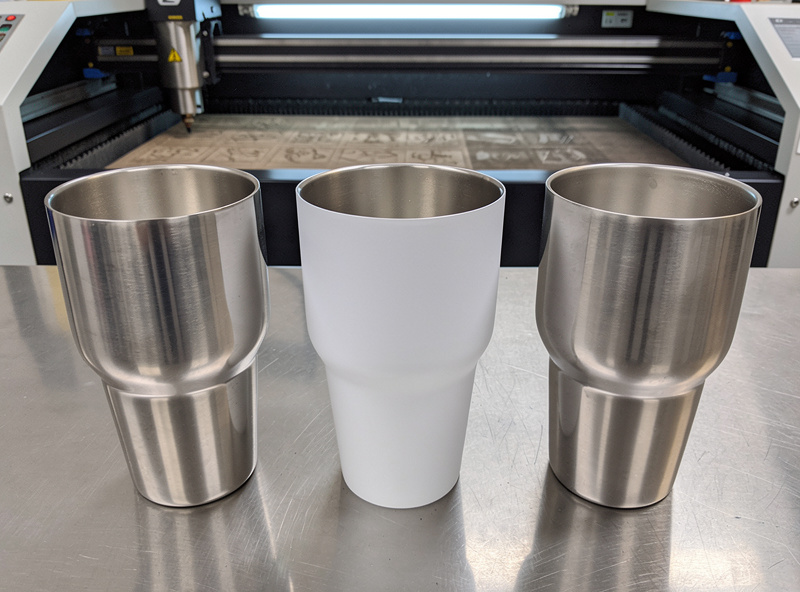
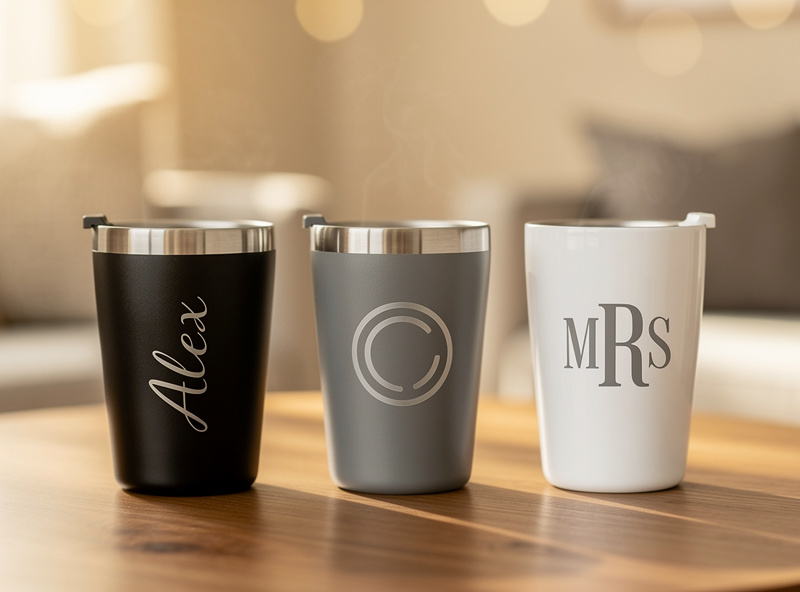
Tumbler designs need to account for the cylindrical wrap. A logo designed for a flat surface will distort across the tumbler curvature unless the slicer compensates — and most slicers do not by default. The fix is designing within a defined “engraving zone” that occupies a known fraction of the tumbler circumference (typically 60–80%) and letting the rotary attachment unwrap the design across that zone.
For a 30 oz YETI tumbler (~9 cm diameter, ~28 cm circumference), the typical engraving zone is 22 cm wide × 8 cm tall. Design within this zone in the laser slicer, set the slicer to “rotary mode,” and the rotary unwraps the flat design onto the curved surface during engraving. Avoid designs that go all the way around the tumbler — the start and end never align perfectly, and any minor misalignment produces a visible seam. Center the design on the front face of the tumbler and leave the back blank for clean retail-quality results.
Production Workflow at Volume
Workshop volume tumbler engraving requires a repeatable workflow. The standard sequence: bulk-purchase blank tumblers (Polar Camel at $9–12 each in 50-piece cases is the common volume blank), pre-clean with isopropyl alcohol, design the personalized engraving file in the slicer, mount in the rotary chuck, run the engraving (60–90 seconds per tumbler with fiber, 3–4 minutes with Cermark), unmount, package for shipping.
The end-to-end time per tumbler at production scale is 4–6 minutes including swap and setup time. At $25–40 retail per personalized tumbler with $9–12 blank cost and $1–3 in laser/materials overhead, the per-tumbler margin is $13–28 — strong margin even after accounting for time and packaging. For sustained workshop production, batch personalized engravings (20–50 tumblers per session) to amortize the rotary-setup time across the run. Etsy and direct-Shopify storefronts are the primary retail channels for personalized tumbler businesses; both support volume orders and the price points support strong margins. Our practical laser projects article covers project economics across material types.
Common Tumbler Engraving Failures
Five common failures produce most rejected tumblers. Skewed designs across the tumbler surface mean the rotary axis was misaligned during setup — re-level and rerun. Inconsistent mark depth on coated tumblers (powder-coated or painted YETI/Stanley) means the laser is not consistently penetrating the coating — increase power 5–10%. Dishwasher fading on Cermark marks usually means insufficient laser power during the original mark — the bond between mark and metal was weak — re-engrave at higher power. Visible “scan lines” across the engraving means the line interval is too wide — reduce from 0.06 mm to 0.04 mm.
The fifth failure is fiber laser focus drift on tumbler diameters that vary across the engraving area. Most Polar Camel and YETI tumblers have a slight taper from base to lip; the focus that is correct at the center may be off at the edges. The fix is automatic focus adjustment if your fiber laser supports it (xTool F1 Ultra, OMTech Maker series), or manual focus adjustment to the engraving-area center. Our general laser troubleshooting article covers the diagnostic flow for inconsistent results.
Frequently Asked Questions
What laser settings for engraving stainless steel tumblers?
80% power, 1000 mm/min, 30 kHz frequency on a 30W fiber laser. This produces permanent dark gray marks on raw stainless. CO2 and diode lasers cannot mark raw stainless directly without a marking spray.
Can I engrave stainless tumblers with a CO2 laser?
Only with marking sprays like Cermark LMM-6000 or LaserBond100. The spray bonds to the metal under CO2 laser exposure, producing a permanent mark. Adds $0.75–1.50 per tumbler in materials cost and extra processing steps.
Do I need a rotary attachment for tumbler engraving?
Yes, for any cylindrical surface. The xTool RA2 Pro, Atomstack R3 Pro, and OMTech rotary chuck all work on most lasers. The setup takes 5 minutes per session and supports common tumbler diameters from 20 to 40 oz.
Are laser engraved tumblers dishwasher safe?
Yes for fiber laser direct marks. Yes for properly applied Cermark or LaserBond100 marks at full power. The marks are bonded to the metal at the molecular level. Marks made at low power may fade over time in the dishwasher.
How long does it take to engrave one tumbler?
60–90 seconds with a 30W fiber laser at standard settings. 3–4 minutes with Cermark on a CO2 laser including spray, dry, engrave, and rinse steps. Setup time adds 5 minutes per session for the rotary attachment.
Why does my tumbler engraving look skewed across the surface?
The rotary axis is misaligned. Use a laser level or printed alignment chart to verify the tumbler is horizontal in the rotary chuck. Most rotary attachments have leveling adjustments to compensate for tumbler height differences.
Is engraving tumblers profitable?
Very profitable. Blank Polar Camel tumblers cost $9–12; personalized retail prices average $25–40. The per-tumbler margin is $13–28 with 4–6 minutes total production time. Volume sellers using fiber lasers earn $30–50 per hour at this rate.