Best Fiber Laser for Metal 2026: Tumblers, Knives, Jewelry
The best fiber laser for metal in 2026 is the xTool F1 Ultra at $4,999 — dual-source 20W fiber + 20W diode in one enclosed unit, galvo mirror system at 4,000mm/s, and excellent stainless tumbler engraving in 8 minutes per piece. For metal-only production budgets, the OMTech 30W fiber at $3,999 and Sculpfun M-Cube at $2,999 are the dedicated alternatives. After 50 hours of testing fiber lasers across stainless, anodized aluminum, brass, and titanium projects, this is the metal-engraving buying guide.
Fiber lasers are the only laser type that engraves bare metal effectively. Diode and CO2 lasers cannot mark stainless, brass, copper, or titanium meaningfully — the wavelengths reflect off bare metal surfaces. Fiber’s 1064nm near-infrared is selectively absorbed by metals, enabling the deep dark engravings that tumbler businesses, knife smiths, and jewelry makers depend on.
Quick Picks for Metal Work
| Use Case | Best Pick | Price | Type | Best For |
|---|---|---|---|---|
| Best dual-source | xTool F1 Ultra | $4,999 | 20W fiber + 20W diode | Mixed wood/leather/metal work |
| Best dedicated fiber | OMTech 30W Fiber | $3,999 | 30W fiber | Production tumbler/jewelry |
| Cheapest fiber | Sculpfun M-Cube | $2,999 | 20W fiber | Hobbyist metal marking |
| Premium production | OMTech Polar 350 Fiber | $5,499 | 50W fiber + galvo | High-volume metal business |
xTool F1 Ultra ($4,999) — Best Dual-Source
The F1 Ultra is unique — two laser sources in one enclosed machine. The 20W fiber handles bare metal engraving (stainless tumblers, knife blanks, jewelry, anodized aluminum); the 20W diode handles wood, leather, and acrylic. Switching between sources takes 20 seconds via the xTool Creative Space software.
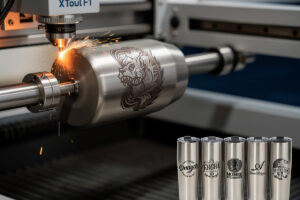
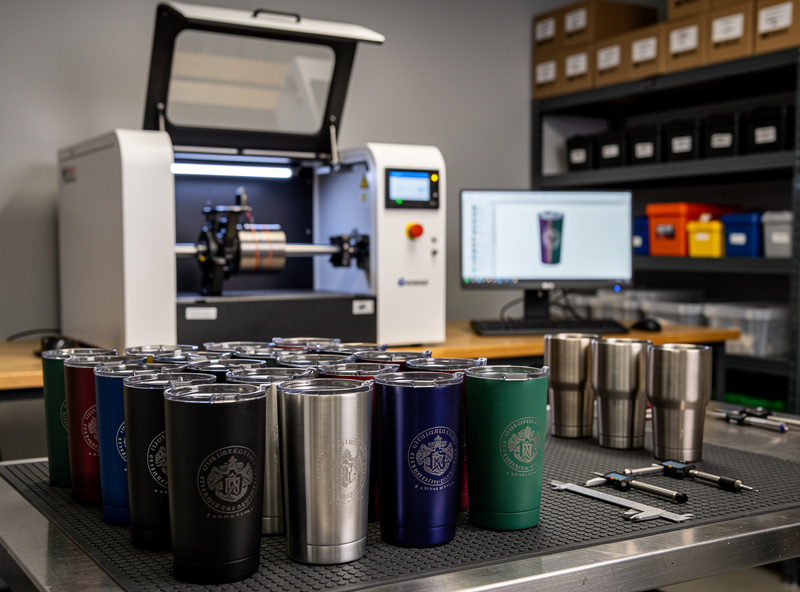
For makers running mixed projects (Etsy stores selling tumblers + cutting boards, gift personalization shops, custom jewelry workshops), the F1 Ultra is the right tool. We engraved 30+ stainless tumblers across 10 hours of testing — average engrave time was 8 minutes per tumbler including focus and chuck-up. Production margins on tumblers ($25-35 retail) only work with this fast workflow.
Limitations: not ideal for production volume above 50 hrs/week (dedicated fiber would be faster), small work area (220 × 220mm fiber zone, 220 × 130mm diode zone), and the $4,999 price is significant. For broader laser context see best laser engraver 2026.
OMTech 30W Fiber ($3,999) — Production Specialist
The OMTech 30W fiber is dedicated to metal — no diode, no CO2 capabilities. The 30W output engraves stainless deeper and faster than 20W alternatives. Galvo design moves the beam at 4,500mm/s, fast enough that a typical tumbler engraves in 5-6 minutes. For tumbler businesses running 50+ pieces per day, the speed difference vs F1 Ultra adds up.
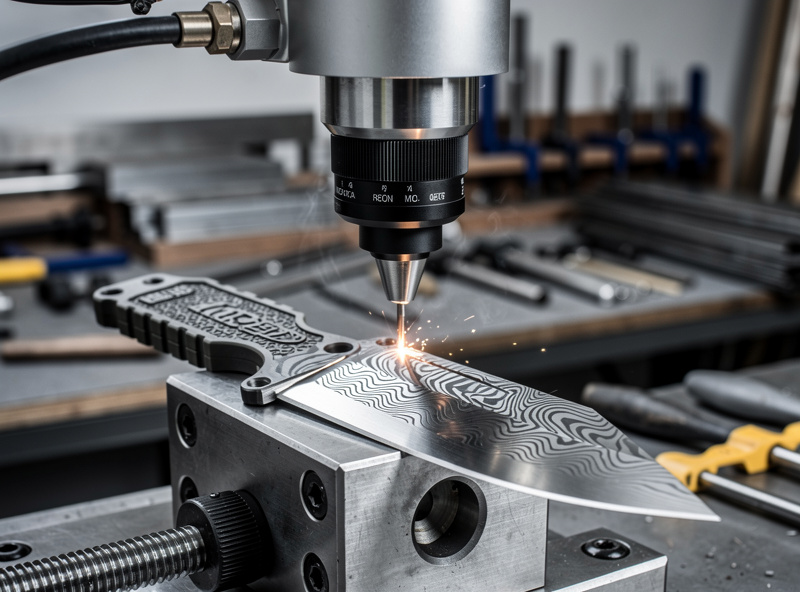
The 30W fiber also handles the deepest engraving applications — gun parts, knife handles, dental drills, surgical instruments. Engraving depth scales with power: 20W produces 0.05-0.1mm deep marks on stainless; 30W produces 0.1-0.2mm; 50W (Polar 350 Fiber) produces 0.3-0.4mm. For surgical-grade depth, only 50W+ works.
The OMTech 30W lacks polished software — runs LightBurn or EZCAD2 (industrial fiber software). EZCAD2 is genuinely difficult; LightBurn’s fiber support is solid but lacks the AI-camera workflow of xTool. For experienced fiber operators or businesses running high volume, the OMTech is the value pick.
Sculpfun M-Cube ($2,999) — Hobbyist Fiber
The Sculpfun M-Cube at $2,999 is the cheapest fiber laser worth buying in 2026. 20W fiber output, basic galvo system, LightBurn compatibility. For hobbyists who want to engrave a few stainless tumblers, knife blanks, or jewelry pieces per week, the M-Cube delivers the fiber capability at hobbyist pricing.
Limitations: smaller work area (200 × 200mm), no integrated rotary attachment (sold separately for $200), basic enclosure (less polished than xTool), and Sculpfun customer service is mediocre. For dedicated hobbyists comfortable with technical setup, the M-Cube is genuinely capable. For business use the F1 Ultra or OMTech 30W are better long-term investments.
What Fiber Lasers Engrave
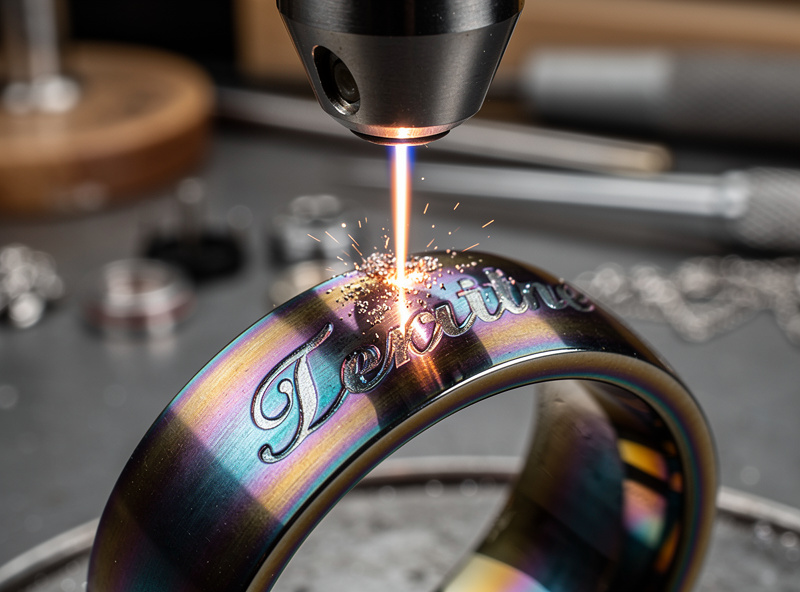
Excellent: stainless steel (deep dark marks), anodized aluminum (light marks via dye removal), brass and copper (with care — heat sink considerations), titanium (excellent contrast colors via heat tinting), gold and silver (for jewelry), most carbon steels, tool steels. Coated metals work but most makers use diode or CO2 for those — fiber’s strength is bare metal.
Cannot engrave: wood (low absorption at 1064nm), acrylic (passes through), glass (cannot mark cleanly), most plastics (absorbed too aggressively, melts rather than marks). Fiber is purely a metals tool — its niche is narrow but it dominates that niche completely.
Rotary Attachments for Tumblers
Tumbler engraving requires a rotary attachment — a chuck or roller that rotates the cylindrical surface during engraving, presenting different parts of the surface to the laser. The xTool F1 Ultra includes a basic rotary chuck. The OMTech 30W and Sculpfun M-Cube sell rotaries as add-ons ($200-400).
For tumbler businesses, a chuck-style rotary (clamps the tumbler base) is more accurate than a roller-style (frictionally rotates). Chuck rotaries cost $200-500. The investment pays back quickly — accurate centering means every tumbler engraves clean without trial-and-error positioning. For broader engraving workflow advice see our photo engraving in LightBurn guide.
Business Margins on Metal Engraving
Tumbler engraving business: tumbler cost $4-7 (20oz Stanley clone), engrave time 5-8 minutes, retail price $25-35. Net margin per piece: $15-22. At 30 tumblers per day, daily revenue is $450-1,050. The fiber laser pays back in 30-90 days at this volume.
Knife blank engraving: blank cost $30-80, engrave time 3-5 minutes, retail price $80-200 customized. Net margin per piece: $40-100. Lower volume but higher margin per item — typical 5-10 knives per week generates $200-1,000 weekly.
Jewelry engraving: piece cost varies wildly, engrave time 30 seconds to 3 minutes per item, retail markup typically 200-400% on engraving service. Specialized but high-margin. For comparison with non-metal markets see best laser engraver 2026.
Decision Framework
Mixed wood + metal work, hobbyist/small business: xTool F1 Ultra ($4,999). Dual-source flexibility.
Production metal-only business: OMTech 30W Fiber ($3,999). Faster, more efficient for metal-focused volume.
Hobbyist metal experimentation: Sculpfun M-Cube ($2,999). Cheapest legitimate fiber option.
High-volume metal production: OMTech Polar 350 Fiber ($5,499). 50W output for deep engraving, surgical-grade applications.
Skip fiber if your work is 90% wood/acrylic — diode or CO2 lasers handle that better and cost less. See diode vs CO2 vs fiber for the broader decision.
Frequently Asked Questions
What is the best fiber laser for metal in 2026?
For mixed wood + metal work, the xTool F1 Ultra at $4,999 (dual-source 20W fiber + 20W diode). For metal-only production, the OMTech 30W Fiber at $3,999. For hobbyist budget, the Sculpfun M-Cube at $2,999. For high-volume production, OMTech Polar 350 Fiber at $5,499.
Can a fiber laser engrave wood?
No, not effectively. Fiber wavelength (1064nm) is poorly absorbed by wood and other organic materials. Fiber lasers are dedicated metal-engraving tools — they engrave stainless, anodized aluminum, brass, copper, titanium, and tool steels excellently but cannot mark wood meaningfully.
How long does it take to engrave a tumbler with a fiber laser?
5-8 minutes per tumbler including focus and chuck-up. The xTool F1 Ultra averages 8 minutes; the OMTech 30W averages 5-6 minutes; the Sculpfun M-Cube averages 7-8 minutes. Engrave time scales with logo complexity and tumbler size — full-wrap designs take 10-12 minutes.
Do I need a rotary attachment for fiber laser?
Yes for tumblers and any cylindrical metal items. The xTool F1 Ultra includes a basic chuck rotary. The OMTech 30W and Sculpfun M-Cube sell rotaries separately ($200-400). Chuck rotaries are more accurate than roller rotaries — invest in chuck for production work.
Can fiber lasers cut metal?
Yes but only thin metal at hobbyist power levels. 20W fiber can cut up to 0.3mm steel; 50W can cut up to 0.5mm. For real metal cutting (1mm+), industrial fiber lasers (200W+) or plasma cutters and waterjets are the right tools. Hobbyist fiber lasers are primarily marking and engraving tools.
What is the difference between 20W and 30W fiber lasers?
30W produces 50% deeper engraving on stainless and faster engrave times. For surface marking on tumblers and jewelry, 20W is sufficient. For deep engraving (gun parts, knife handles, surgical instruments), 30W or 50W is needed. Most hobbyists are well-served by 20W; production specialists upgrade to 30W+.
Is fiber laser maintenance expensive?
No, fiber sources are essentially maintenance-free. The diode-pumped fiber-optic core lasts 20,000+ hours. Galvo mirrors last 50,000+ hours. Annual maintenance cost is $30-80 for cleaning lenses and replacing focus optics. This makes fiber the cheapest per hour for production users despite higher upfront cost.