Slate Laser Engraving: Settings, Soap Trick, and Project Ideas
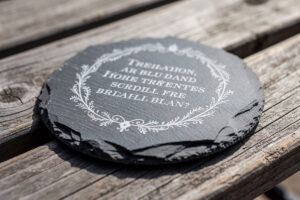
Slate laser engraving produces some of the most striking visual results available to small CO2 lasers — the white engraved text against dark gray slate creates instant high-contrast designs without paint, ink, or finishing. After engraving 30+ slate coasters, signs, and plaques in 2026, my settings live in a narrow window — on my OMTech Polar 350 (a 50W desktop CO2) slate lands in the high-60s on power at 600 mm/min, laid flat (not raised) on the bed. A diode will mark slate, but in my logs it comes out faint — the blue light doesn’t couple well into slate’s minerals — so I leave slate to the CO2, which marks faster and far more evenly across a large piece.
This article covers slate-specific settings, the dish-soap technique that produces the smoothest finish, slate sourcing tips, and the limitations every slate engraving project hits eventually. It is the slate companion to our laser cutting materials hub, and it sits within the wider laser engraving stone guide that covers tile, granite, marble, and travertine alongside slate.
As an Amazon Associate I earn from qualifying purchases — at no extra cost to you. The slate and finishing supplies I link below are what I actually keep on the bench for these projects.
Why Slate Engraves Cleanly
Slate is a metamorphic rock made of fine clay particles compressed under heat and pressure. The dark gray-to-black surface contains minerals that absorb laser energy efficiently. When the CO2 laser hits the surface, the energy fractures the top 0.05–0.10 mm of mineral structure, exposing the lighter mineral layer beneath. The result is a clean white-on-dark engraving without depth — the laser does not cut into the slate, it surface-fractures the upper mineral layer.
Unlike materials where laser power scales with cut depth, slate engraving has a hard ceiling. Past 60% power on a 60W CO2 (or 80% on a 40W CO2), the slate surface chips rather than fractures cleanly, producing rough, flaky engravings instead of smooth white text. The technique is fundamentally about controlled surface fracture, not removal. Diode lasers (450 nm) interact poorly with slate minerals — when I’ve run slate on my Atomstack X20 Pro the result is a light-gray, faded engrave even at full power; the wavelength just doesn’t couple with the slate chemistry. CO2 (10,600 nm) is the practical requirement. Our laser type comparison covers the wavelength-mineral interaction.
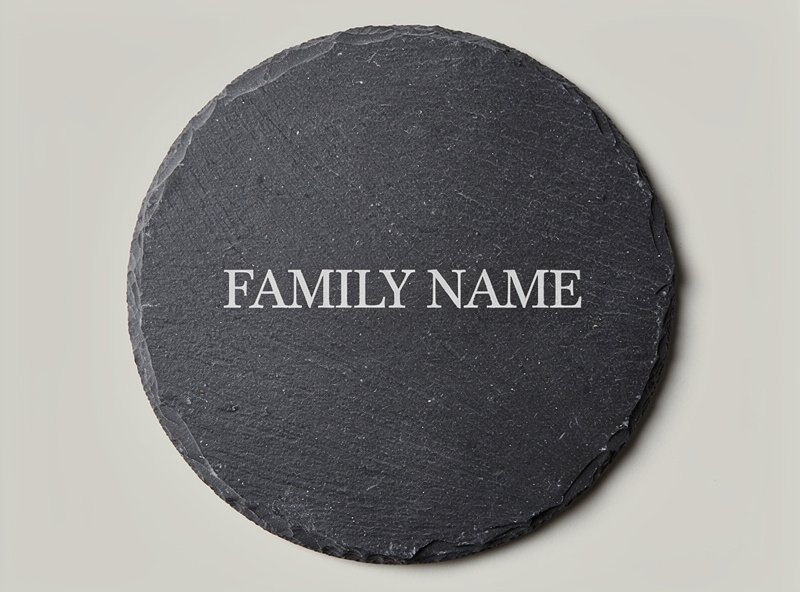
Slate Engraving Settings
| Slate Type | CO2 60W | CO2 40W | Notes |
|---|---|---|---|
| Standard slate coaster | 60%/600 mm/min, 0.1 mm interval | 80%/500 mm/min, 0.1 mm interval | The default starting point |
| Premium thick slate (8 mm+) | 65%/600 mm/min, 0.1 mm interval | 85%/500 mm/min, 0.1 mm interval | Slightly higher power for darker slate |
| Slate sign / plaque (large) | 60%/700 mm/min, 0.12 mm interval | 80%/600 mm/min, 0.12 mm interval | Wider line interval saves time |
| Photo engraving on slate | 50%/800 mm/min, 0.08 mm interval | 75%/700 mm/min, 0.08 mm interval | Lower power for tonal range |
For most CO2 machines the “60% power, 600 mm/min, 0.1 mm interval” line on a 60W (or the 40W equivalent) is the universal starting point; my own 50W Polar 350 sits a hair above the 60W numbers. Whatever you run, I treat slate like any new material — I pull a 25 mm test square off my materials test card on each new batch before committing a real project. If it looks chipped or rough, I drop power 5%; if it’s faint, I add 5%. Every slate lot has slightly different mineral content, and that 30-second test has saved me more coasters than any single setting ever has. Slate is about as low-drama as laser materials get — no flame, no real fume — but the air assist and ducted exhaust still run on every pass; that’s a build-once decision on my bench, not a per-material one.
The Dish Soap Technique
The single biggest visual upgrade I’ve found for slate is a thin layer of dish soap on the surface before engraving. The soap absorbs heat evenly across the engraving area, reducing the chip-and-flake variation that produces uneven results on bare slate. The soap also keeps small slate particles attached during the laser pass, producing a smooth velvet finish instead of a rough fractured one.
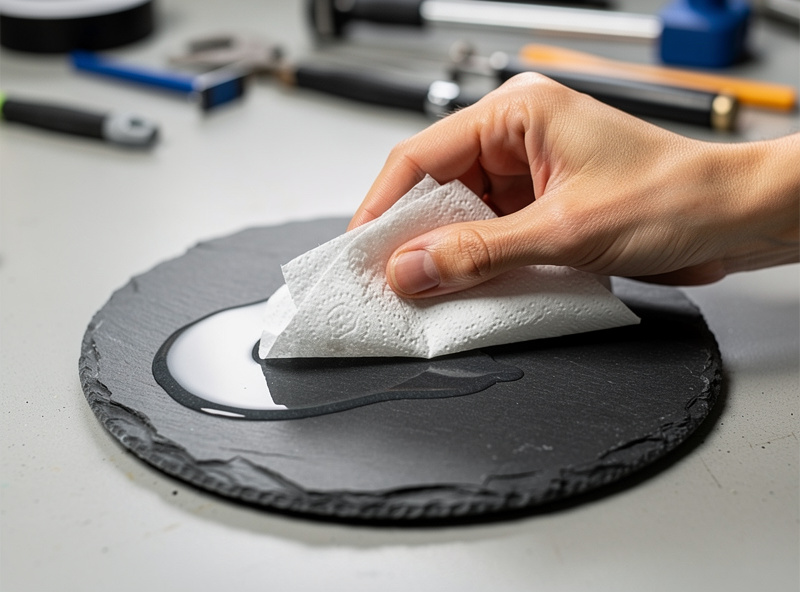
The application: squeeze a few drops of standard dish soap (Dawn, Palmolive, generic) onto the slate surface and spread thin with a paper towel until the entire engraving area is lightly coated. Do not over-apply — heavy soap layers absorb too much energy and prevent the engrave from happening. The right amount is barely visible after spreading. Engrave normally; the soap evaporates during the laser pass. After engraving, rinse the slate under cool water to remove residual soap and slate particles, then air-dry. The result is a clean, smooth white engraving that looks like commercial sandblasting.
Slate Sourcing
Most laser-suitable slate comes from craft suppliers or restaurant supply stores. Standard slate coasters (4-inch round, 6-inch square) cost $1.50–4.00 each — the blank slate coasters sold on Amazon are the cheapest way to dial in settings, with Hobby Lobby and Etsy slate vendors as alternatives. Larger slate signs and house-number blanks (8×12 inch, 12×18 inch) cost $8–20 each. The batch-to-batch variance is real — some slate I’ve bought engraves clean, others have natural seam lines or color variation that fights the engrave.
The one slate I avoid is anything from outdoor or landscape suppliers — those are often sealed with mineral wax or weather coatings that ruin a laser engrave. Indoor decorative slate from craft retailers is unsealed and engraves cleanly. The premium tier is hand-cut Welsh or Vermont slate ($20–60 each) for specialty projects; the average user does not need this level of slate quality. Tandy Leather, Inventables, and Glowforge Proofgrade also sell laser-tested slate at slight markups for guaranteed results. Our materials hub covers craft material sourcing.
Common Slate Projects
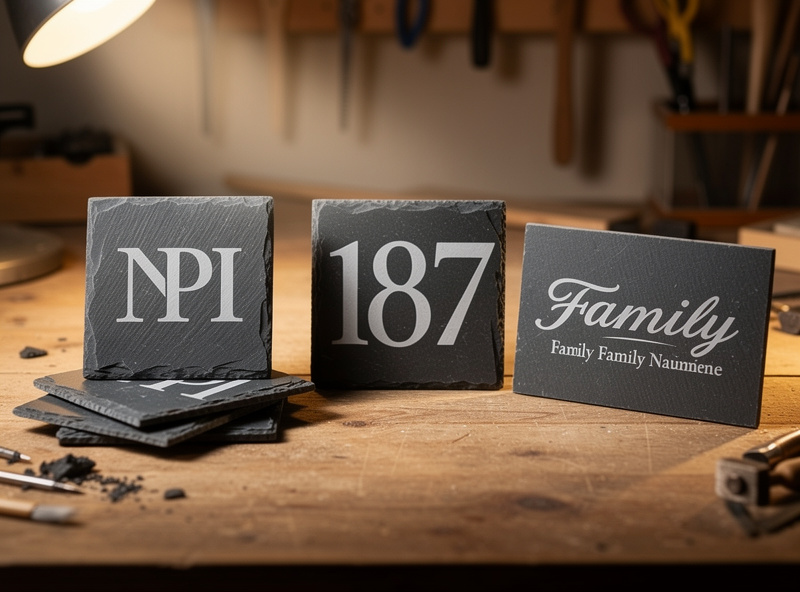
Slate punches well above its material cost — it’s one of the highest-margin materials I run. A $2.50 coaster routinely retails in the $12–15 range once it’s engraved. House number signs ($8 raw) sell for $35–55. Family-name plaques ($15 raw) sell for $50–80. The retail margin is generally 4–6x raw material cost across slate products, which compares favorably with most laser materials.
The volume products: coaster sets (4-pack with monograms, $25–35), house number signs, anniversary gifts with date and names, restaurant table signs, and pet memorial plaques. Etsy is the primary retail channel for laser-engraved slate; the search term “personalized slate coaster” returns thousands of products with visible price differentiation by quality. Production-quality slate engravings (smooth dish-soap technique, even contrast, sharp text) consistently sell in the $30+ range. Our practical laser projects article covers project-specific techniques.
Slate Engraving Limitations
Slate engravings are surface fractures, not deep-cut grooves. The engraved area is roughly 0.1 mm deeper than the surrounding surface — visible to the touch but not dramatically so. For projects that need deep tactile engraving (like Braille or 3D logos), slate is the wrong material. Use wood, acrylic, or wood-fill epoxy resin instead.
Slate also cannot be cut — only engraved. The laser cannot remove enough material to cut through even thin slate. Pre-cut shapes (round coasters, rectangular plaques) are the only available form factors; custom shapes require sourcing pre-cut slate or accepting standard rectangles. For custom shapes, consider Baltic birch plywood with a dark stain — the visual result mimics slate without the cutting limitation.
Post-Processing and Finishing
Straight off the laser, engraved slate looks slightly dusty — fine particles cling to the fractured area. I rinse it under cool running water and let it air-dry. For permanent display use, optionally apply a clear matte sealer (Krylon Clear Acrylic Coating, Rust-Oleum Matte Clear) to the engraved face. The sealer protects the engraving from dirt absorption during use and locks in the contrast.
For coasters that will see liquid contact (the most common slate use), no sealer is needed — the slate is naturally water-resistant. Wipe with a damp cloth periodically to clean. For outdoor slate signs (house numbers, garden markers), a UV-resistant clear sealer extends visible life by years; without sealing, weathered slate gradually absorbs surface stains that reduce engraving contrast over 6–12 months. For indoor decorative use, no finishing is required and the natural slate appearance is the appeal.
Frequently Asked Questions
What laser settings for slate engraving?
60% power and 600 mm/min on a 60W CO2 with 0.1 mm line interval. 80% power and 500 mm/min on a 40W CO2. The default produces clean white engraving on dark slate. Test on each batch with a 25 mm square first.
Can a diode laser engrave slate?
Not effectively. Diode laser wavelengths interact poorly with slate minerals and produce light gray faded engravings even at maximum power. CO2 is the practical requirement for clean white-on-dark slate engraving.
Why use dish soap when engraving slate?
It produces smoother, more uniform engraving by absorbing heat evenly and keeping fractured slate particles attached during the laser pass. The result is a velvet-smooth finish instead of a rough chipped one — the biggest visual upgrade for slate engraving.
Can a laser cut slate?
No. Lasers can only engrave (surface-fracture) slate, not cut through it. Use pre-cut slate shapes (round coasters, rectangular plaques, signs) and accept those form factors. For custom shapes, use wood instead.
Where should I buy slate for laser engraving?
Craft suppliers (Amazon slate coasters, Hobby Lobby, Etsy slate vendors) offer the most economical indoor-grade slate. Avoid outdoor/landscape slate which often has surface coatings that interfere with laser engraving.
Does engraved slate need to be sealed?
For indoor decorative use, no. Slate is naturally water-resistant and engravings hold contrast indefinitely. For outdoor use, a UV-resistant clear matte sealer extends visible life and prevents weather-related staining.
How profitable is selling laser engraved slate?
Very profitable for a small workshop. Raw slate coasters cost $1.50–4.00 each and sell engraved for $12–15. Larger signs sell for 4–6x raw material cost. Etsy and local craft fairs are the primary retail channels.