Galvo vs Gantry Fiber Laser: Which to Buy for Metal
The short answer: a galvo fiber laser steers the beam with two tilting mirrors across a small fixed field, marking at thousands of mm/s, while a gantry machine physically drags the laser head along X/Y rails over a large bed. Galvo wins on metal-marking speed; gantry wins on big work area.
I run both architectures on my bench every week. I’ve got a desktop fiber/MOPA galvo marker for metal, and gantry machines covering the rest: an xTool S1 enclosed diode, an Atomstack X20 Pro open-frame diode, and an OMTech Polar 350 CO2. They are not interchangeable, and the marketing blurs the line on purpose. This guide is the explanation I wish someone had handed me before I bought my first galvo, so you don’t pay for the wrong motion system. For the bigger picture on metal work, start at my fiber laser metal marking guide.
How the beam actually moves: mirrors vs rails
The core difference is mechanical. A galvo uses two galvanometer-driven mirrors to deflect a stationary beam across a fixed scan field; a gantry moves the whole laser head on rails over the part. On my galvo, nothing the size of the head moves over the work — the mirrors flick, and that’s why it marks in the thousands of mm/s.
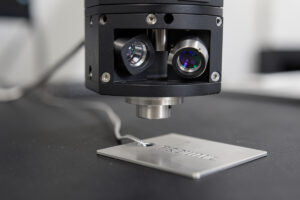
On a galvo head, the fiber source fires a 1064nm beam into a pair of mirrors mounted on galvanometer motors. Those motors tilt a fraction of a degree, thousands of times per second, sweeping the beam through an F-theta lens that flattens the focus across the marking field. There’s almost no inertia to fight — you’re moving two tiny mirrors, not a pound of laser module. That’s the whole speed story. On my fiber marker I routinely run vector marking at 2,000 to 4,000 mm/s, and fill passes faster than my eye can track.
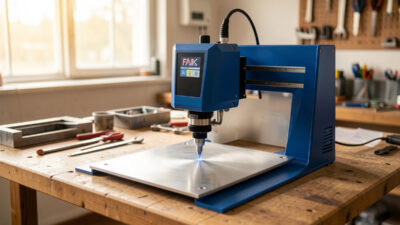
A gantry is the opposite philosophy. The beam path is fixed relative to the head, and the head itself rides belts or lead screws along an X-axis beam that in turn rides the Y rails. Every diode and CO2 machine I own works this way. My Atomstack tops out around 600 mm/s for engraving and far slower for clean cuts, because you’re accelerating and decelerating real mass at every direction change. The payoff is that the bed can be as big as the frame — my CO2 covers a full work area a galvo field could never reach. If you’re still deciding between laser families, my diode vs CO2 vs fiber breakdown covers which beam suits which material.
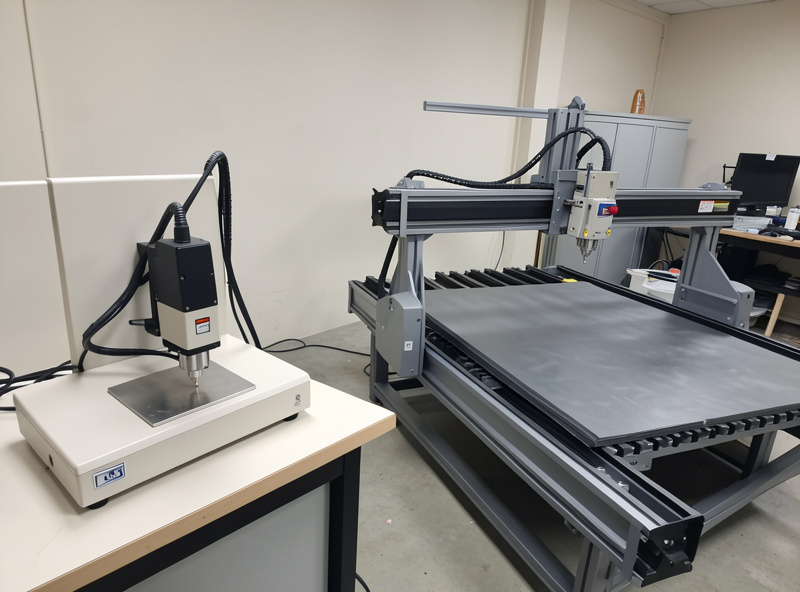
The comparison table I’d tape to the wall
Here’s the side-by-side I actually use when someone asks which to buy. Read it as galvo for fast metal marking on small parts, gantry for large-format cutting and engraving. The single biggest spec people miss is field size: a galvo’s marking field is fixed by its F-theta lens, typically a square in the 110-200mm range.
| Trait | Galvo fiber (mirror-steered) | Gantry (rail-moved head) |
| How the beam moves | Two galvanometer mirrors tilt to steer a fixed beam | Head physically travels on X/Y rails over the bed |
| Work / field size | Small fixed field, roughly 110-200mm square per lens | Large, scales with the frame; full-size beds common |
| Marking / cut speed | Very fast: thousands of mm/s on metal marking | Slower: hundreds of mm/s, mass limits acceleration |
| Precision / edge behavior | Excellent center; slight edge distortion the F-theta corrects | Consistent across the bed; limited by belt/screw backlash |
| Focus method | Manual Z per part; no autofocus across the field | Z height set per job; some add autofocus probes |
| Best use | Fast metal marking, serial numbers, small deep engraving | Large-format cutting and engraving, big or odd parts |
| Rough price tier | Entry desktop fiber from a few hundred up to several thousand | Diode hundreds; desktop CO2 low thousands; flatbed far higher |
Why galvo is the standard for fiber metal marking
Galvo dominates fiber metal marking for two reasons: raw speed and the fact that a small fixed field is genuinely fine for the job. Most metal marking is tags, plates, tools, and serial numbers — parts that fit inside a 150mm square. You rarely need a big bed to laser a data plate.
When my fiber marker burns a batch of stainless tags, it’s done before a gantry machine would finish homing. Speed compounds in production: a barcode or serial that takes a galvo a second or two would tie up a gantry head for many times that, because the head has to physically travel and reverse for every stroke. For throughput on small repeated parts, the galvo isn’t just faster, it’s a different category. That’s also why MOPA galvo sources earn their keep — adjustable pulse duration lets you pull color on stainless, which I cover in my MOPA stainless color marking guide.
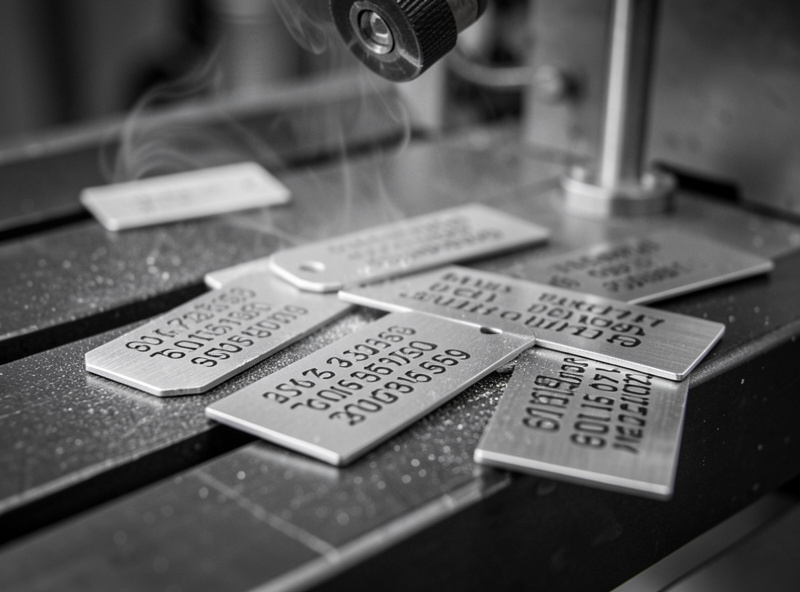
The fixed small field is a feature, not a compromise, for this work. The F-theta lens that defines the field also keeps the spot focused and roughly perpendicular across the whole square, so a serial number reads as crisply in the corner as it does dead center. For deeper cuts into metal, the same galvo speed lets you stack many fast passes — see my deep metal engraving guide for how I layer those. And if you’re unsure whether you even want marking, engraving, or etching depth, my marking vs engraving vs etching guide sorts the terms out.
Why gantry is the standard for large-format diode and CO2 work
Gantry rules everything that needs a big bed: plywood, acrylic, leather, slate, large signs. None of that fits a galvo field, and none of it needs galvo speed. The trade you accept is acceleration — moving a real head means real mass, so cut speeds live in the hundreds of mm/s, not thousands.
When I cut a 400mm sign blank on my CO2, the only architecture that works is a gantry, because the head has to physically reach every corner of the part. A galvo simply cannot address that area without tiling, and tiling a one-off cut is pointless. The same goes for my diode machines doing photo rasters on big wood panels — the work area is the whole point, and rails are the only way to get it. For picking your first machine across all of this, my first-laser decision framework walks the whole tree.
Gantry precision is consistent rather than spectacular: it’s limited by belt or lead-screw backlash, not optics, so a well-tuned machine holds tolerance evenly across the bed. There’s no edge distortion to correct because there’s no fixed field — the head just goes where it’s told. That predictability across a large area is exactly what large-format cutting needs, and it’s why the architecture hasn’t changed in decades.
F-theta, focus, and marking bigger than the field
The F-theta lens is the part nobody explains. It sets your marking field, keeps the beam focused and flat across that square, and corrects the geometric distortion that mirror-steering would otherwise cause. Bigger field means a bigger, more expensive lens — and a little more edge distortion to manage.
Here’s the rule I tell people: pick the smallest F-theta lens that fits your parts. A 110mm lens gives a smaller, tighter spot and faster marking for fine detail; a 200mm lens covers bigger parts but with a larger spot and slightly softer corners. You swap lenses, and you re-set focus, because the focal distance changes with the lens. On my bench I keep a focus stick cut to each lens’s working distance so I’m not guessing.
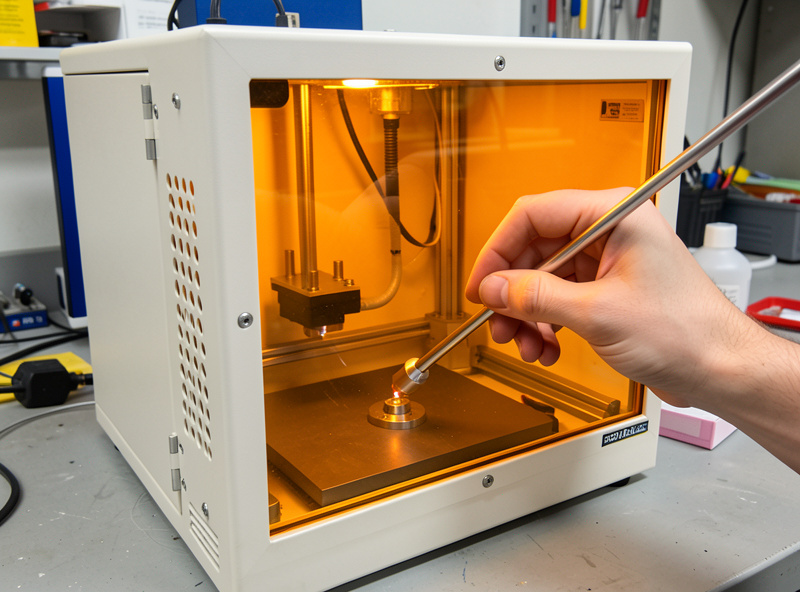
Focus on a galvo is per-part on the Z axis — there is no autofocus across the field. You set the focal distance once for a flat part and the F-theta keeps it sharp corner to corner, but a part with varying height needs you to pick the height that matters or accept softening elsewhere. The industrial side runs around this with dynamic-focus 3-axis galvo heads that move focus on the fly, but that’s a five-figure capability, not a desktop one.
To mark larger than the field, you split-field or tile: mark one field, move the part or an X/Y stage, re-register, and mark the next. Large-format operators report stitched fields working well for repeated patterns, but the seam alignment is fiddly and it’s slower than a single pass. If your parts routinely exceed your field, that’s a sign you actually want a gantry, not a bigger galvo.
When a hobbyist actually needs each one
Buy a galvo if your work is metal marking on small parts: tags, knives, tools, jewelry, EDC, serial plates. Buy a gantry if you cut or engrave large or non-metal material: wood, acrylic, leather, slate signage. The mistake I see most is buying a galvo dreaming of cutting sheet steel.
A desktop galvo fiber does not cut sheet metal in any practical hobby sense. Cutting steel is the domain of high-wattage fiber flatbed systems — those exist, but they’re industrial fiber flatbed cutters with the economics to match, not a bench tool. If someone shows you a 20-30W desktop galvo “cutting” metal, look closely: it’s thin foil, many passes, and not a process you’d run for real parts. Set that expectation before you spend.
If your honest answer is “both” — you mark metal AND cut wood — that’s two machines, and that’s fine. I run them side by side precisely because no single motion system does both well. Anyone selling you one box that cuts large acrylic and marks fast metal is selling you a compromise on both. Across the machines I’ve run, the specialist always beats the generalist at its own job.
Safety: the part that isn’t optional
Fiber at 1064nm is invisible and will damage your retina before you know it happened — this is a different hazard class than a visible diode. Run a galvo in an enclosure with the correct 1064nm-rated window, air assist on, exhaust ducted outside, and never unattended.
Three rules I do not bend, on any machine on my bench. First, 1064nm eye safety: a fiber beam is invisible and far more dangerous than the red diode glow people respect — you need an enclosure and a window rated for 1064nm, full stop, and OD-rated glasses as backup, not as the primary control — I treat the ANSI Z136.1 laser-safety standard as the floor for any fiber source. Second, air assist on every job and exhaust ducted physically outside the building; metal marking throws fine fume you do not want in your lungs, and I never run any laser on PVC, vinyl, or unknown-coated stock because chlorine gas is a non-negotiable ban. Third, fire kit within reach and never, ever run a job unattended — galvo jobs are fast, but fast doesn’t mean safe to walk away from. If you don’t have suppression sorted, fix that first with my fire suppression guide.
So which should you buy?
Match the motion system to the work, not the hype. Galvo for fast metal marking on small parts inside a fixed field; gantry for large-format cutting and engraving where work area is the priority. If you need both, that’s two machines — which is exactly how I run my bench.
For a concrete fiber pick once you’ve decided galvo is your lane, see my best fiber laser for metal roundup. And if you mark coated or anodized work where chemistry matters more than wattage, my CerMark and Thermark guide covers the marking compounds I keep on the shelf. As an Amazon Associate I earn from qualifying purchases. If you want to browse current galvo fiber markers, this search is a reasonable starting point — just match the field size to your parts before you buy.
Frequently asked questions
What is the difference between a galvo and a gantry fiber laser?
A galvo steers a fixed beam with two tilting mirrors across a small fixed field, marking at thousands of mm per second. A gantry physically moves the laser head on X and Y rails over a large bed, slower but with a much bigger work area.
Can a galvo fiber laser cut metal?
Not in any practical hobby sense. A desktop galvo marks and deep-engraves metal but does not cut sheet steel. Cutting steel needs high-wattage industrial fiber flatbed systems, not a bench galvo marker. Expect marking and engraving, never real cutting.
What does the F-theta lens do on a galvo laser?
The F-theta lens sets the marking field size and keeps the beam focused and flat across that square, correcting distortion from mirror steering. A bigger field needs a bigger lens with a larger spot and slightly softer corners, so pick the smallest lens that fits your parts.
How do you mark something larger than the galvo field?
You split-field or tile: mark one field, move the part or an X Y stage, re-register, then mark the next field. It works for repeated patterns but seam alignment is fiddly and slower. If parts routinely exceed your field, a gantry machine is the better tool.