Cleaning Laser Lenses and Mirrors: The Safe Method
A film of smoke residue you can barely see on a laser lens robs real cutting power and, left long enough, builds a hot spot that cracks the optic mid-job. On the machines I run, the lens and the lowest mirror get wiped after almost every session, because they sit closest to the plume. The whole job takes under five minutes with lens tissue and the right solvent — and doing it wrong, with a paper towel or a hard scrub, scratches a coating that scatters the beam permanently.
This guide covers cleaning both CO2 lenses and mirrors the safe way: what to use, what to never use, and how often. It is one node in my laser maintenance guide, and it goes hand in hand with mirror alignment — clean optics first, then align, never the other way around. Diode owners clean something different; that is the diode module cleaning guide.
Why dirty optics cost you more than power
Every surface the CO2 beam touches — each mirror and the focusing lens — should reflect or transmit nearly all of it. Smoke residue, resin haze, and the fine spatter that comes off cutting wood and acrylic settle on those surfaces and absorb energy instead of passing it. You lose wattage at the work, and the optic heats up where the residue sits. On a lens, that localized heating is what cracks ZnSe optics; a clean lens runs cool, a dirty one runs hot.
The surface closest to the smoke fouls fastest. On a CO2 machine that is the focusing lens and Mirror 3 on the head, which is why those get the most frequent attention. Mirror 1 at the back, tucked away from the cutting zone, stays clean far longer. Match your cleaning effort to where the residue actually lands rather than scrubbing everything on the same schedule.
What to use, and what to never use
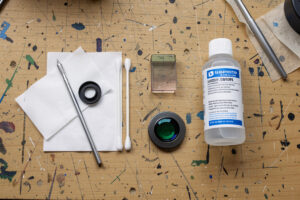
The supplies are specific. Lens-grade tissue or cotton swabs, a proper optics cleaner or high-purity (99%+) isopropyl alcohol, and a bulb blower to clear loose grit before any wiping. That last step matters: a single grain of grit dragged across a coated lens leaves a scratch, and a scratch is forever. Always blow first, wipe second.
What you must never reach for is just as important. No paper towel, no shop rag, no eyeglass spray with additives, no acetone on coated optics, and no rubbing hard. The coatings on CO2 lenses and mirrors are soft and delicate compared to the glass you are used to. The goal is to float the residue off with a damp tissue and a feather touch, not to polish it away.
| Use | Avoid |
|---|---|
| Lens tissue / cotton swabs | Paper towel, shop rag, tissue paper |
| 99%+ isopropyl or optics cleaner | Acetone, household glass spray, water |
| Bulb blower for loose grit | Compressed-air cans (propellant residue) |
| Light, single-direction wipes | Scrubbing, circular pressure, re-using a dirty swab |
Cleaning the focusing lens, step by step
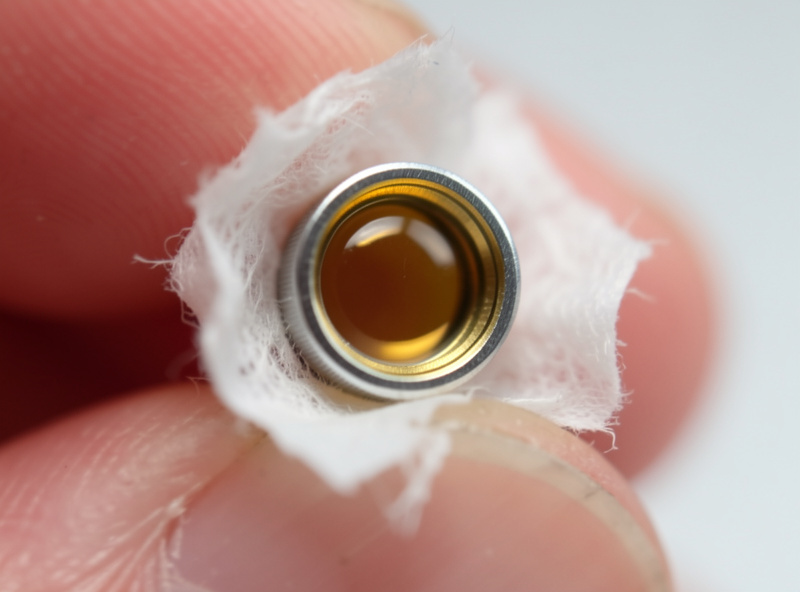
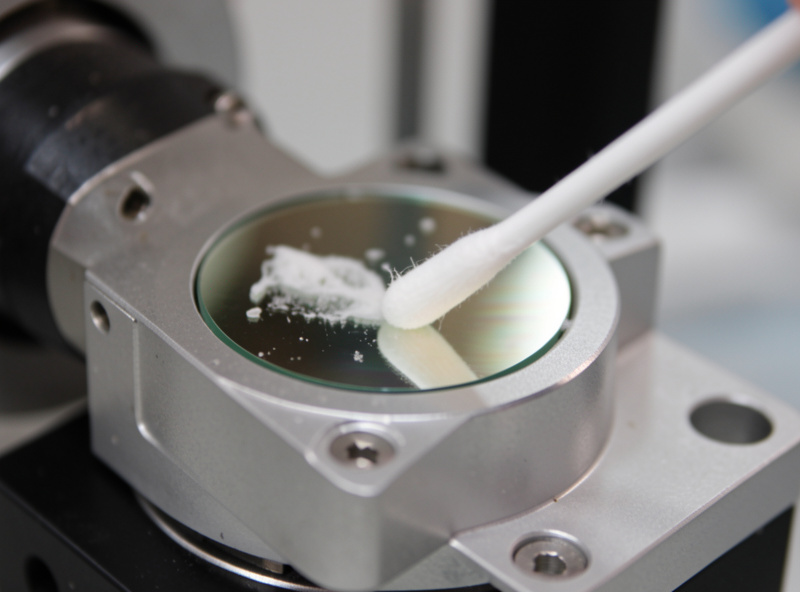
Remove the lens from its holder if your machine allows it — cleaning in place risks dripping solvent into the head. Note its orientation first; a CO2 focusing lens has a curved side that must go back facing the same way, and reinstalling it flipped ruins your focus. Blow off loose debris, then dampen a fresh lens tissue or swab with isopropyl and wipe across the surface once in a single direction, lifting at the end of the stroke.
Turn to a clean part of the tissue for each pass; never drag the residue you just collected back across the glass. Two or three light passes usually clear a normal session’s haze. For stubborn baked-on spatter, let a damp tissue rest on the spot for a few seconds to soften it rather than pressing harder. Inspect against the light, reinstall in the correct orientation, and you are done. If the haze will not lift at all, the lens may be pitted or its coating damaged — that is a replacement, covered in my focusing lens upgrade guide.
Cleaning the mirrors
Mirrors clean the same way as the lens, with one extra caution: most mirror surfaces are front-coated, meaning the reflective layer is on the exposed face with nothing protecting it. You are touching the working surface directly, so the light-touch rule is non-negotiable. Many people leave Mirror 1 and Mirror 2 in place and clean them where they sit, taking care not to bump the mount and disturb alignment — if you do nudge a mount, plan to re-align afterward.
Dampen a swab, wipe once, rotate to clean cotton, wipe again, and stop as soon as the surface is clear. Resist the urge to keep going on a mirror that already looks clean — every wipe is wear. After cleaning, a quick alignment check confirms nothing shifted. The payoff is real: a fully clean optical train often restores cutting performance people had written off as a tired tube.
How often, and the habits that keep optics clean longer
My rhythm is simple. The lens and lowest mirror get a quick wipe after almost every session of cutting wood or acrylic; the upper mirrors get inspected weekly and cleaned only when they need it. The single biggest thing that keeps optics clean is air assist — a strong stream of air at the nozzle blows debris down and away from the lens instead of letting it drift up onto the glass. I run a dedicated air-assist pump on every cut, and it does more to keep the lens clean than any cleaning routine, as I cover in my air assist setup guide.
Good extraction helps too, pulling the smoke plume away before it settles. And the material you cut matters: cutting oily or resinous stock fouls optics far faster, while masking your work reduces spatter. Whatever you do, never cut PVC, vinyl, or unknown coated stock — beyond the chlorine-gas danger to you and the machine, the residue it leaves is corrosive to optics.
Frequently Asked Questions
How often should I clean my laser lens and mirrors?
Wipe the focusing lens and lowest mirror after almost every session of cutting wood or acrylic, since they foul fastest. Inspect the upper mirrors weekly and clean them only when residue is visible. Frequent light cleaning beats occasional heavy scrubbing, which wears the coatings.
Can I use regular isopropyl alcohol to clean laser optics?
Use high-purity isopropyl, 99% or better, or a dedicated optics cleaner. Lower-grade rubbing alcohol contains water and additives that leave streaks on coated optics. Never use acetone on coated lenses or household glass cleaner, and always blow off loose grit before wiping.
What happens if I clean a laser lens with a paper towel?
Paper towels and shop rags are abrasive enough to scratch the soft coatings on CO2 optics, and any scratch scatters the beam permanently. Always use lens tissue or cotton swabs with a light, single-direction wipe. One grain of dragged grit is enough to ruin a lens.
Does cleaning the lens restore lost cutting power?
Often, yes. A hazed lens and fouled mirrors absorb beam energy instead of delivering it, so a full optics cleaning frequently restores performance people had blamed on a dying tube. Clean the optics before suspecting the tube or running an alignment pass.
Which way does the focusing lens go back in?
A CO2 focusing lens has a curved side that must face the same direction it came out, usually curve-up toward the beam on common desktop heads. Note the orientation before removing it, because reinstalling it flipped destroys your focus even though the lens is perfectly clean.