Pricing Laser Engraving Work: The Costing Formula
To price laser engraving work, add four real costs — material, machine time, labour, and a share of overhead — then apply a margin on top. The number most beginners miss is machine time: a sixty-second engrave plus masking and weeding is real minutes the laser bed can’t sell twice, and pricing on material alone is how you end up working for free.
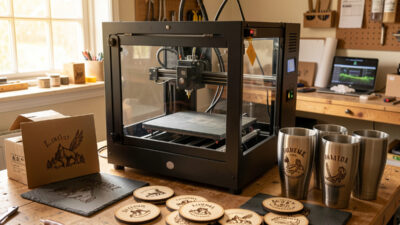
I run this costing on every product before it goes in my catalogue, across the diode, CO2, and fiber machines on my bench, and the discipline is always the same. This guide gives you the formula, a worked example you can copy, and how to handle the awkward cases — one-off customs, rush jobs, and bulk orders — without falling back on a gut guess. It’s the pricing half of the wider laser engraving business guide.
Why guessing your price is the costliest mistake
The most common pricing failure is anchoring to material cost. A seller buys wood coaster blanks at under a dollar each, sees “cheap material,” and prices the finished coaster at three dollars — then discovers that between design setup, masking, the engrave, weeding, cleaning, and packing, they spent ten minutes and a chunk of machine wear to make a dollar. Multiply that across a busy weekend and the business is actively losing money while looking busy.
The fix is to treat your laser bed as a rentable asset with a fixed number of productive minutes per day and price every job so it pays its share of running the whole operation. Once you cost a product properly one time, you reuse that number forever — pricing is a one-time calculation per product, not a per-order agony.
The four-part costing formula
Every engraved product’s true cost is the sum of four components, and your price is that sum plus margin. Written out: Price = (Material + Machine Time + Labour + Overhead share) × Margin multiplier. Each piece is simple on its own; the value is in not skipping any of them.
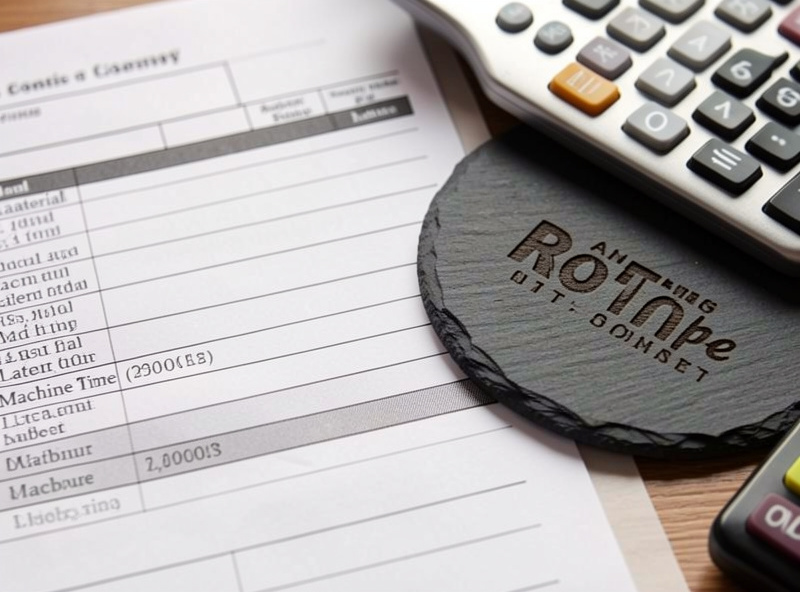
Material is the blank plus consumables (masking tape, finishing oil, the cardboard you ship it in). Machine time is the minutes the job occupies the bed, costed at a rate that covers electricity, lens and consumable wear, and the opportunity cost of the bed. Labour is your hands-on time — design, jig loading, masking, weeding, cleaning, packing — which on small items often dwarfs the engrave itself. Overhead is the slice of rent, software subscriptions, and machine depreciation each item should carry. Margin is what turns cost recovery into profit.
Component 1: Material and consumables
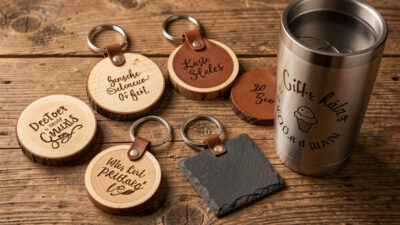
Cost the blank at your real wholesale price, not retail, and include the small consumables people forget. A slate coaster might be the blank, a square of masking, a dab of sealant, and a poly sleeve — pennies individually, but they add up across hundreds of pieces. Buying blanks by the case rather than singly is what makes this number small enough to leave margin, which is exactly why wholesale sourcing is a pricing decision, not just a procurement one.
One discipline protects this number: every new lot of blanks gets a materials test card before you quote in volume. A batch of slate that needs two passes instead of one doubles your machine time, and you want to know that before you’ve priced and sold forty of them.
Component 2: Machine time and profit-per-minute
This is the component that separates profitable shops from busy ones. Assign your laser an hourly rate that covers electricity, air-assist and exhaust running cost, consumable wear (lenses, diodes, lens-protection), and a depreciation slice so the machine eventually replaces itself. Whatever rate you settle on, divide it down to a cost-per-minute and multiply by the actual job time, including framing and any second passes.
The reason this matters so much is that the bed is your bottleneck. The most useful single metric in the whole business is profit-per-minute of bed time: a small keychain that nets a few dollars in ninety seconds outperforms a large sign that nets more in absolute terms but ties up the machine for twenty minutes on a day full of orders. When you have to choose which products to push, push the ones with the highest profit-per-minute, not the highest sticker price.
Component 3: Labour — the hidden time sink
Hands-on labour is where small-item pricing quietly breaks. The engrave on a leather patch might be forty seconds, but the design tweak, the masking, the alignment, the lint-roll, and the packing are five minutes of you. Price your own time at a real hourly rate — the rate you’d actually want to earn — and apply it to the whole hands-on cycle, not just the part where the laser is moving.
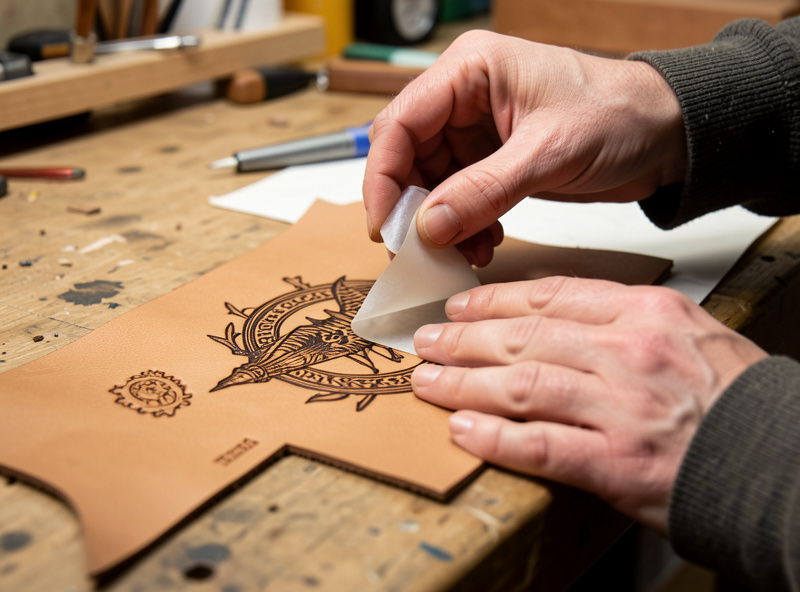
This is also the strongest argument for batch production and reusable jigs: anything that cuts the per-item labour cycle drops your cost and lifts your margin without touching the price. A jig that loads twelve coasters at once turns twelve alignment cycles into one, and that saved labour is pure margin.
Component 4: Overhead, margin, and marketplace fees
Overhead is the easy one to forget because it’s not attached to any single item: workshop space, LightBurn and design-software costs, the exhaust system’s power, and machine depreciation. Estimate your monthly overhead, divide by a realistic monthly output, and add that per-item slice. Then apply your margin multiplier — cost recovery is survival, margin is the actual point of the business.
Finally, work backward from your selling channel. If you sell on Etsy, the effective platform and payment fees take roughly a tenth of the sale before you see it, so your target price has to absorb that and still clear your margin. The same product priced for a marketplace and for a local craft fair will carry different fee loads — price each channel for what it actually costs to sell through.
A worked example: engraved slate coaster
Here’s the full calculation on a single product so you can see every component land. The numbers are illustrative — plug in your own rates — but the structure is exactly what I use.
| Cost component | Basis | Per-item cost |
|---|---|---|
| Material | Slate blank (wholesale) + masking + sleeve | \$1.10 |
| Machine time | 2.5 min bed time at a \$24/hr machine rate | \$1.00 |
| Labour | 4 min hands-on at a \$20/hr personal rate | \$1.33 |
| Overhead share | Per-item slice of monthly fixed costs | \$0.50 |
| Total cost | \$3.93 | |
| Price at 2.5× margin | Covers cost + profit + fee headroom | ~\$9.83 |
Round to a clean retail number, sanity-check it against what comparable personalized coasters actually sell for in your market, and you have a defensible price. Notice the engrave itself — the part beginners price on — is barely a quarter of the true cost. That’s the whole lesson.
Pricing customs, rush orders, and bulk
Three situations break the standard formula and each has a clean rule. For a one-off custom design, add a flat design fee that captures the extra setup and file work, because a bespoke layout is real labour the standard price never accounted for. For rush orders, add a rush premium — you’re buying back bed time and bumping the queue, and that has a price. For bulk, you can discount, but only because batch efficiency genuinely lowers your per-item labour: the discount should come out of saved time, never out of margin you can’t spare. Never discount to a number below your true cost just to win a big order — a hundred units at a loss is a hundred-times loss.
Frequently Asked Questions
How do I price laser engraving per item?
Add material cost, machine time, hands-on labour, and a slice of overhead, then multiply by a margin. The often-missed piece is machine time plus labour: the engrave is usually a small fraction of true cost, while masking, weeding, and packing dominate on small items.
What hourly rate should I charge for laser engraving?
Set two rates: a machine rate covering electricity, consumable wear, and depreciation, and a personal labour rate for your hands-on time. Many small shops land on a machine rate in the low tens of dollars per hour and a separate personal rate, then cost each job in minutes.
Should I charge a setup or design fee?
Yes, for any custom or one-off design. A bespoke layout involves file work and test runs the standard per-item price never accounted for. A flat design fee captures that real labour and stops custom orders from quietly running at a loss.
How do I account for Etsy fees in my price?
Work backward from the sale: platform and payment fees take roughly a tenth of an Etsy sale before you see it. Build that into the target price so the listing still clears your margin after fees, rather than discovering the shortfall after the sale.
Is profit-per-minute really more important than price?
For deciding which products to push, yes. The laser bed is your bottleneck, so a fast small item that nets a few dollars per minute of bed time can out-earn a slow large item with a higher sticker price across a busy day. Track profit-per-minute, not just margin.